Walking north from College Street along University Avenue, the granite facade of the Ontario Legislative Building appears with little warning—a Romanesque pile of pink sandstone that seems to have grown from the escarpment itself. This is Queen's Park, the small circular green at the head of the avenue, and the seat of Ontario's provincial government since 1893. The building's architect, Richard Waite, reportedly designed it to look as though it had always been there。anchoring the province's political life to the bedrock. It is a rare thing in North American cities: a seat of power that feels geologically inevitable rather than merely constructed.The park's ground is often taken for granted by the civil servants and lawyers who cross it daily, heads down against the wind. Yet it functions as a carefully calibrated civic space. On any given Tuesday。you might find a cluster of elementary students sitting on the grass, sketching the building's turrets for a social studies assignment;a few steps away, a press conference unfolds on the front steps, cameras clustered around a minister announcing new funding. The juxtaposition is not accidental. Queen's Park was designed as both a stage and a refuge, a place where the public can approach power without being swallowed by it. The absence of barriers around the lawn is a quiet but deliberate statement.
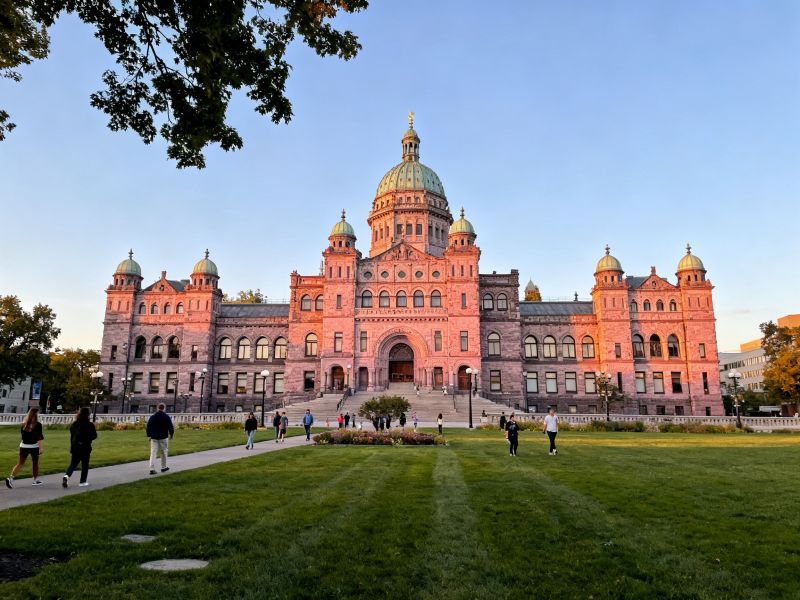
History presses close here. Statues of Queen Victoria and King Edward VII stand in stiff bronze formality, but the more interesting figures are the ones less often noticed: the monument to the Canadian Volunteers who fought in the Boer War, and the plaque commemorating the first sitting of the Ontario legislature in 1867. A personal observation—these markers are invariably read by tourists from other provinces, while locals hurry past. The building itself has survived fires, renovations, and at least one serious proposal in the 1960s to demolish it for a modernist replacement. That plan collapsed under public protest。a reminder that Queen's Park's value is not purely architectural. It is a stubborn, unglamorous symbol of continuity.The surrounding streets tell a different story. Queen's Park Crescent, which curls around the legislative grounds, is a favourite of Toronto's cycling community—not because it is safe, but because it is scenic and slightly absurd, a grand ceremonial approach that ends in a loop. On weekday mornings, the intersection at Wellesley Street becomes a bottleneck of ambulances from Toronto General Hospital and delivery vans servicing the nearby offices. The park, in other words。
is not an isolated monument;it is a working participant in the city's circulatory system. Its trees (a mix of maples, oaks, and a few struggling elms) provide the only substantial canopy in this stretch of downtown, and on hot July afternoons, the shade is claimed with quiet determination by office workers eating lunch out of plastic containers.What makes Queen's Park worth defending is precisely this lack of preciousness. No one treats it as a museum. The grass is worn in patches where people cut across the lawn. The fountain on the east side, installed in 1970, has been repaired more times than anyone can count. And the building itself, with its asymmetrical towers and heavy stone。still looks faintly out of place—a piece of Victorian ambition dropped into a city that now surrounds it with glass condominiums. That tension is the point. Queen's Park does not resolve Toronto's contradictions;it houses them, session after session, in a building that was never designed to be beautiful, only to last.